
WordPress Metadata & SEO Details:
Exploring Wallaceburg’s Military History: Inside War Memorial Park & Its Historic M109 Howitzer
Slug: wallaceburg-war-memorial-park-m109-howitzer
Meta Description: Take a tour of Wallaceburg’s War Memorial Park in Ontario, Canada. Discover the story behind its monuments, local heroes like Cpl. Don Errey, and the iconic M109 self-propelled howitzer on display.
Introduction: Honoring Valor in Small-Town Canada
Across Canada, small towns hold rich layers of national history. Deep in Southwestern Ontario lies Wallaceburg, a community whose sons and daughters have answered the call to serve in significant conflicts for over a century. Located at a key downtown intersection near the Sydenham River, Wallaceburg War Memorial Park acts as an outdoor museum and a space for reflection.
In a video titled “Tank as a museum property” by the channel Alf Blop, viewers are guided through this park. From granite monuments etched with local names to a striking military vehicle resting under trees, the site connects past sacrifices with present-day remembrance.
Whether you are a military history fan, a heritage traveler, or simply want to see how small communities honor veterans, this overview highlights the monuments, stories, and historical significance presented in the video.
Video Overview & Walkthrough Highlights
The video offers a visual tour of the park on a bright summer day. Below are the main monuments featured throughout the walkthrough:
[00:00] – The Canadian Service Granite Monument: The tour opens with a close-up of a large granite stone honoring Canadian military contributions during World War I, World War II, the Korean War (1950-1953), and ongoing United Nations Peacekeeping missions since 1956.
[00:27] – The “We Will Remember Them” Name Plaques: The camera shows carved granite panels adorned with dozens of names of local service members who fought and died for freedom.
[00:56] – World War I “Lest We Forget” Memorial: A dedicated granite marker pays tribute to those who served in the First World War (1914-1918), featuring carved Remembrance Day poppies.
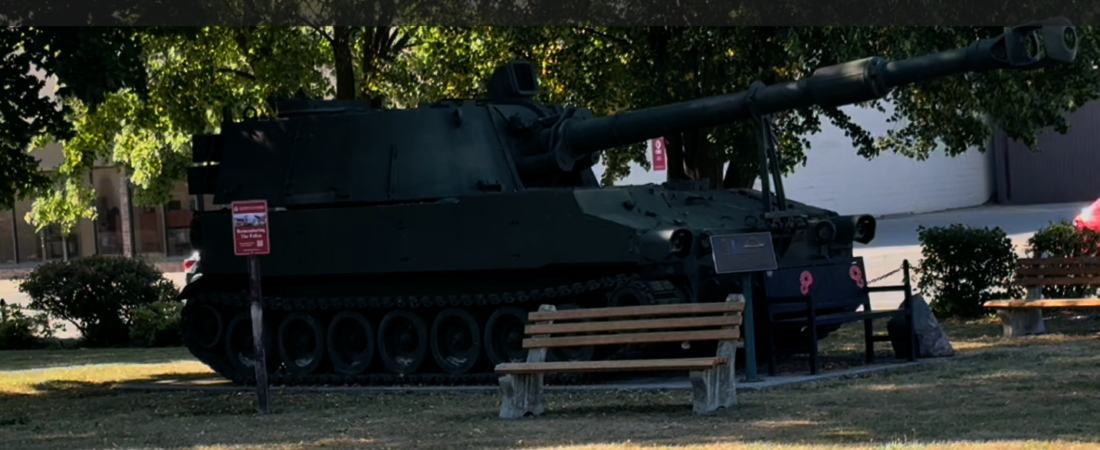
[01:23] – The M109 Self-Propelled Howitzer: The camera moves through the central green space to reveal an M109 155mm self-propelled howitzer positioned beside park benches, serving as a physical symbol of Canadian armored and artillery history.
[02:00] – The Cpl. Donovan (Don) Errey Memorial Bench: A black granite bench honors a local war hero, Corporal Donovan Errey of the Essex-Scottish Regiment. His remarkable story of survival and ingenuity during World War II continues to inspire.
[02:45] – The Main Cenotaph & Soldier Statue: The camera tilts up to feature the original cenotaph monument erected by Capt. J.W. Steinhoff. It is topped by a statue of a soldier flanked by the Canadian national flag and the Ontario provincial flag.
[03:20] – Detailed View of the M109 Display: The video concludes with a close-up of the M109 armored vehicle, showcasing its heavy tracks, long barrel, and muzzle brake against the backdrop of downtown Wallaceburg.
Key Features of Wallaceburg War Memorial Park
- The Service & Sacrifice Granite Monolith
At the entrance of the memorial area stands a granite monolith engraved with the Canadian Maple Leaf and Canadian Red Ensign/National insignia. The inscription reads:
“During World Wars I and II, 64 million lives were lost and many more changed forever. Canada’s military served honorably, and their great sacrifice forged a new world. Not only did this win freedom, it shaped the identity of a nation and earned Canada newfound respect around the world.”
The monument honors Canadian Peacekeepers who have served globally since 1956. It emphasizes Canada’s shift from wartime combatant to international peacekeeping leader during the Cold War and beyond.
- The Rocks of Honour & Roll of Remembrance
As shown at [00:00:30] and [00:01:40], the park features multiple “Rocks of Honour.” These polished granite stones list local family names—Murrays, Myers, O’Neils, Pearsons, and many others—who enlisted from Wallaceburg and surrounding Chatham-Kent townships.
Having these names inscribed in stone creates a real connection for local residents. Descendants walking through the park can see the names of grandfathers, uncles, and neighbors who served in battles across Europe, Asia, and the Middle East.
- The Incredible Story of Cpl. Donovan “Don” Errey
One of the most compelling stops in the video occurs at [00:02:00], where the camera focuses on a dark granite memorial bench. The inscription tells the extraordinary story of a local hero:
Regiment: Essex-Scottish Regiment
Conflict: The Dieppe Raid (August 19, 1942)
The Story: Corporal Don Errey was captured during the ill-fated Allied raid on Dieppe, France, where his brother Victor was killed. While held in a German Prisoner of War (POW) camp, Don used basic tools to create a makeshift artificial leg for a wounded Royal Canadian Air Force (RCAF) officer.
Legacy: By the time the war ended in 1945, Cpl. Errey had built over 350 prostheses for fellow prisoners of war, significantly improving their mobility and quality of life while in captivity.
This story changes the park from a site of general remembrance to a narrative of extraordinary human spirit and local resilience.
- The M109 155mm Self-Propelled Howitzer
The vehicle referred to in the video title as a “tank” is an M109 155mm Self-Propelled Howitzer ([00:01:25]). It is often confused with a traditional main battle tank due to its tracked chassis and large turret, but the M109 is an armored self-propelled artillery unit.
Technical & Historical Context:
Role: Primary mobile artillery support for mechanized infantry and armored divisions.
Armament: 155mm heavy artillery gun capable of firing high-explosive projectiles over long distances.
Canadian Army Service: The Canadian Forces operated M109 variants (including the M109A4+) for decades as part of the Royal Regiment of Canadian Artillery, especially during NATO deployments in Europe during the Cold War.
Preservation Status: When retired from active service, several hull units were decommissioned, demilitarized, and given to Canadian towns, legions, and war museums to serve as public monuments honoring artillery veterans.
Seeing this massive armored vehicle sitting peacefully among green grass and park benches creates a strong visual contrast between wartime machinery and community peace.
- The Historic Main Cenotaph
At [00:02:45], the video highlights the towering main cenotaph erected by Capt. J.W. Steinhoff. Surmounted by a sculpted figure of a World War I infantryman holding a rifle at ease, the pillar bears inscriptions for:
World War I: 1914 – 1918
World War II: 1939 – 1945
Korean War: 1950 – 1953
Afghanistan War: 2001 – 2014
This multi-generational monument shows how community remembrance alters over time, adding new conflicts as generations step forward to serve.
Why Local War Memorials Matter Today
Public war memorial parks like the one in Wallaceburg play an important role in community heritage and history education:
Accessible History: They serve as open, free-access museums where visitors can interact with historical artifacts without needing a ticket or formal gallery setting.
Personal Connection: Seeing local names and reading personal stories, such as that of Cpl. Don Errey, brings national military history to a human level.
Preservation of Military Hardware: Displaying retired equipment like the M109 howitzer allows military enthusiasts, students, and armor fans to examine real military technology up close.
Visiting Wallaceburg War Memorial Park
If you plan to visit Southwestern Ontario, Wallaceburg offers a charming, history-rich stop along the waterways of Chatham-Kent.
Location: Corner of Dufferin Avenue and McNaughton Avenue / Lord Street, Wallaceburg, Ontario, Canada.
Nearby Landmarks: Located next to the Sydenham River bridge, local banks, and walking paths.
Best Time to Visit: Spring through autumn for clear views of the monuments and outdoor exhibits.
Frequently Asked Questions (FAQ)
Is the vehicle in the video a real tank?
Technically, it is an M109 Self-Propelled Howitzer, which is a tracked armored artillery piece rather than a frontline main battle tank. However, it shares many visual traits with tanks, such as caterpillar tracks and an armored turret.
Who was Cpl. Donovan Errey?
Cpl. Don Errey was a Wallaceburg native who served with the Essex-Scottish Regiment. After being captured at Dieppe in 1942, he created over 350 artificial limbs for fellow POWs in German camps, earning him recognition as an “Unlikely Hero.”
Can visitors view the park for free?
Yes, Wallaceburg War Memorial Park is a public municipal park open 24/7 with no admission fee.
Conclusion
The video “Tank as a museum property” offers a peaceful look at Wallaceburg War Memorial Park. Through its monuments, engraved names, historic M109 howitzer, and inspiring stories of wartime ingenuity, the park serves as a tribute to those who served and sacrificed.
If you enjoy discovering local history, military monuments, and hidden gems across Canada, be sure to watch the original video to experience this quiet sanctuary of remembrance firsthand.
Video Details & Author Information
- Video Title: Tank as a museum property
- Watch Video: https://youtu.be/j1zwt6TPPOE
- Author / Channel: Alf Blop
- Copyright Notice: All rights reserved / Copyrights reserved by Alf Blop.