
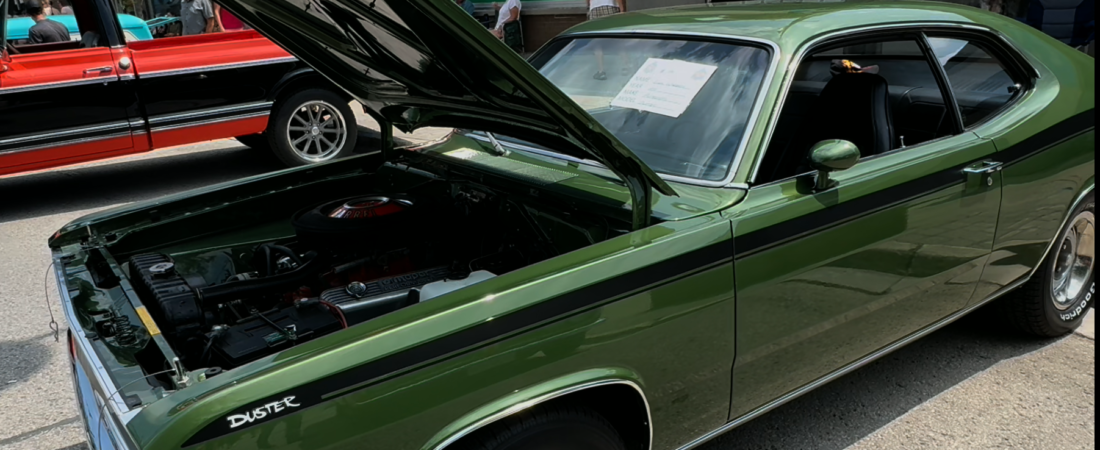
There’s a definite kind of magic that occurs when classic American muscle cars are placed in the bright summer sunlight. The deep sound of a high-performance engine, the shine of hand-polished chrome, and the vivid factory paintwork from the golden age of automotive engineering all at once take car enthusiasts right back to the past. This particular car is highlighted in a compelling video tour called “The Ultimate Auto Show” by Alf Blop on YouTube (http://www.youtube.com/watch?v=Ubs6cxZVhKc), and one outstanding example takes center stage, fully representing all that we admire about old-style muscle cars: a perfectly preserved 1971 Plymouth Duster 340.
It is owned by Lorri Wardell and is entry number 98 at this local car show [00:29], and it is a prime example of the ingenuity displayed by the Chrysler Corporation at the height of the muscle car competition. Whether you are a devoted Mopar collector, someone who enjoys restoring cars, or just someone who appreciates classic design and genuine horsepower, this thorough examination looks closely at what makes the 1971 Plymouth Duster 340 such a lasting legend in the history of automobiles.
The Origin of an Unlikely Legend: How Plymouth Changed the Market
To fully understand this remarkable 1971 Plymouth Duster, it’s necessary to look at the circumstances under which it was developed. By the late 1960s, the American muscle car market was thriving, but it was also becoming more expensive. Insurance rates for high-horsepower vehicles were starting to rise sharply, and the prices of top-of-the-line muscle cars such as the Plymouth GTX, the Dodge Charger, and the Pontiac GTO were moving beyond the reach of many young buyers.
Plymouth saw a gap in the market: drivers who were looking to save money still wanted the look, the aggressive style, and the quarter-mile acceleration of a true muscle car, without having to pay the high price. In response, Plymouth engineers used the compact A-body platform—originally used in the reliable Plymouth Valiant—as the basis for a completely new kind of car.
For the 1970 model year, the Plymouth Duster was introduced with a semi-fastback coupe body style, featuring sweeping rear side windows, a striking front grille, and an aggressive posture. While the base models were aimed at everyday economy, Plymouth launched a powerful version with the Duster 340 model. By fitting a high-revving 340-cubic-inch V8 engine into a light-bodied chassis, Plymouth produced a budget supercar that could outpace many more expensive vehicles on the drag strip.
By 1971, the Duster had established itself as a major commercial success, confirming it as one of Chrysler’s wiser business decisions of that period.
Under the Hood: Power, Engineering, and Mopar Precision
As can be seen in the detailed examination of the engine compartment [00:07], the main feature of this 1971 Plymouth Duster is its well-known 340-cubic-inch (5.6-litre) V8 engine. Enthusiasts from all over the world regard the Mopar 340 small-block as one of the best performance engines ever made in Detroit.
Key Engine Features and Upgrades Visible in the Walkaround:
High-Flow Induction: Prominently located on top of the engine is the iconic round air cleaner assembly marked “4 BARREL” [00:11]. This shows the high-performance four-barrel carburetor setup, which is designed to provide the best air and fuel mixture for maximum throttle response.
Mopar Performance Dress-Up Parts: The engine bay includes classic silver ribbed “Mopar Performance” aluminum valve covers [00:13], giving it a clean, ready-for-show appearance that matches well with the fiery red paint on the engine block [00:17].
Exceptional Restoration Quality: The wiring is noticeably neat, the cooling hoses are in excellent condition, and the radiator has a genuine heavy-duty structure [00:18], all of which show the great care and attention to detail that has been put into maintaining this classic engine bay.
In the 1971 model year, the factory 340 V8 produced a strong 275 gross horsepower and 340 lb-ft of torque. Since the Duster was much lighter than B-body cars such as the Road Runner or the Super Bee, this excellent power-to-weight ratio enabled the Duster 340 to cover the quarter-mile in the low 14-second range right from the dealership showroom floor—a performance that astonished the muscle car competitors of that time.
Exterior Styling: Strong Aesthetic Design and Iconic 340 Graphics
The exterior walkaround shows a magnificent period-accurate dark olive green paint finish [00:23] that reflects natural sunlight beautifully. In 1971, bold colours and aggressive graphics packages were standard for muscle cars, and Plymouth excelled at this kind of visual branding more than almost anyone else.
A characteristic black side stripe runs along the upper body line [00:25], emphasizing the fastback shape of the A-body frame. On the rear quarter panel, the bold “340” graphics [01:07] make it clear for anyone stopping next to it at a traffic light exactly what is under the hood.
Other notable exterior features shown in the video are:
Classic Rally Wheels: Equipped with period-correct raised white-letter performance tyres [01:08], they give the car the right aggressive stance and authentic period style.
Dual Exhaust Outlets: Visible at the rear valence [01:12], they allow the 340 V8 to breathe properly while producing that distinctive Mopar exhaust sound.
Chrome Accents: The front and rear bumpers are polished chrome [01:11], along with clean window trim, showing a high level of preservation.
Inside the Cabin: Simple, Driver-Oriented Design
When the camera turns to the interior, it reveals a beautifully kept cabin [00:44] that reflects the practical, no-frills interior design approach of early 1970s Plymouth performance cars.
Both the driver and the passenger are seated in plush black vinyl bucket seats [00:43] with classic button-tufted patterns. Right in the center of the floor column is a manual floor shift lever with a traditional wooden shift knob on top [00:48]—a feature that immediately appeals to traditional drivers who prefer to manually shift gears rather than use an automatic transmission.
The wood-grain textured dashboard trim contains a full set of round analog gauges [00:46], including those for speed, fuel, temperature, and the alternator [00:55]. The original three-spoke steering wheel with the central Plymouth logo finishes off a cockpit that is as timeless as it is practical. Being inside a cabin like this gives a direct, unfiltered mechanical connection between the driver, the vehicle, and the open road—an experience that is largely missing in today’s car environment filled with screens.
Why the Plymouth Duster 340 is Still a Popular Choice Today
Car shows throughout North America feature a wide range of vintage vehicles, but cars such as Lorri Wardell’s 1971 Plymouth Duster always draw attention and conversation for a very specific reason [00:21]. They represent real automotive nostalgia. For many people looking at the cars at the show, the Duster was the exact car their parents used, the one that their older sibling restored in a home garage, or the vehicle they personally wanted when they were in high school.
Beyond nostalgia, the Duster 340 holds a significant position in automotive history:
Collector Value: Although Hemi Cudas and 440 Six-Pack Chargers can reach auction prices in the six figures, the Plymouth Duster 340 remains one of the most accessible ways to get into genuine 1970s Mopar muscle car ownership.
Aftermarket and Restoration Support: Because of a committed group of enthusiasts and a large number of restoration part suppliers, it is still possible for hobbyists all over the world to maintain and preserve A-body Plymouths.
Unbeatable Street Presence: With its lightweight chassis, the legendary 340 V8 engine, and unmistakable retro styling, the Duster continues to stand up well against heavier muscle car rivals at car cruises and drag races.
Final Thoughts: Preserving American Automotive Heritage
Cars like this 1971 Plymouth Duster 340 act as moving time capsules. They honor an era of free design, mechanical simplicity, and genuine American horsepower. Thanks to dedicated owners who take the time, passion, and effort to keep these classic cars preserved for local shows, future generations can continue to admire and appreciate the rich history of the muscle car movement. If you ever get the opportunity to go to a local car show in your area, look out for the entry numbers tucked into the windshields [00:29]—you might just spot a rare green 340 Duster ready to share its amazing story with you!
Author & Creator: Alf Blop
YouTube Channel: Alf Blop
Copyright: © All Rights Reserved by Alf Blop. Unauthorized reproduction or redistribution of this content without explicit written permission is strictly prohibited.