
The Vision That Never Took Off
In the 1920s American cities were rushing to introduce modern forms of transportation. Because of rapid urbanization and the increasing size of their population centres there was a need for mass transit, which caused the major cities to extend their existing rail systems. Cincinnati took part in this national trend by drawing up an ambitious plan for infrastructure development: converting an old and previously unused canal bed into a modern underground rapid transit system.
The objective was to link the busy downtown area with the suburban residential communities around it. Back then, the city authorities wanted a quick and dependable electric rail system which would help to reduce traffic, encourage local business, and firmly establish Cincinnati as one of the leading industrial and economic centres in North America. The ground was broken, the construction crews moved in, and huge concrete tunnels then started to take form under the city streets.
Progress, however, was quickly brought to a standstill by unexpected global economic and political changes. The period following World War I saw significant financial fluctuations, and by 1929 the arrival of the Great Depression had entirely eliminated any remaining funds. Inflation rose sharply, construction costs went well beyond the original estimates, and public political support declined. Effectively, work on the underground transit line had stopped by 1928.
More than six million dollars was invested in the underground project—a sum equivalent to about one hundred million dollars in today’s money. Nevertheless, the project was given up before any passenger train had even run on its tracks, and the empty concrete caverns remained in the dark, being sealed off and forgotten as the modern city expanded above them.
Decades of Silence Beneath the City
Almost a hundred years later, the subway system in Cincinnati still holds the title of the largest unused transit network in North America. Extending over two miles through underground concrete arches, platforms, and trackways, the system stays concealed only a few feet below the daily street traffic. For many years, local authorities have systematically blocked the access points, ventilation shafts, and entrances in order to stop unauthorised access and to ensure public safety.
Although time has come to a standstill within the place, the surroundings have nevertheless been slowly altered by nature and physical deterioration.
Because they have not received regular maintenance or been exposed to sunlight, extensive parts of the underground system have suffered environmental wear and tear:
Because there are no active pumping systems, seepage from the ground and run-off from rainwater collect in the low-lying areas and turn the trackways into stagnant pools beneath the surface.
Because of decades of exposure to humidity, fluctuations in temperature, and water seeping in, the steel reinforcement has been corroded, the concrete support structures have cracked, and substantial deposits of rust have formed on the structural beams.
A change in the ecosystem has taken place, the result of dark and damp conditions being a secluded ecosystem in which specialized plants and animals flourish, such as cave crickets, fungal growths, and insect populations that live underground.
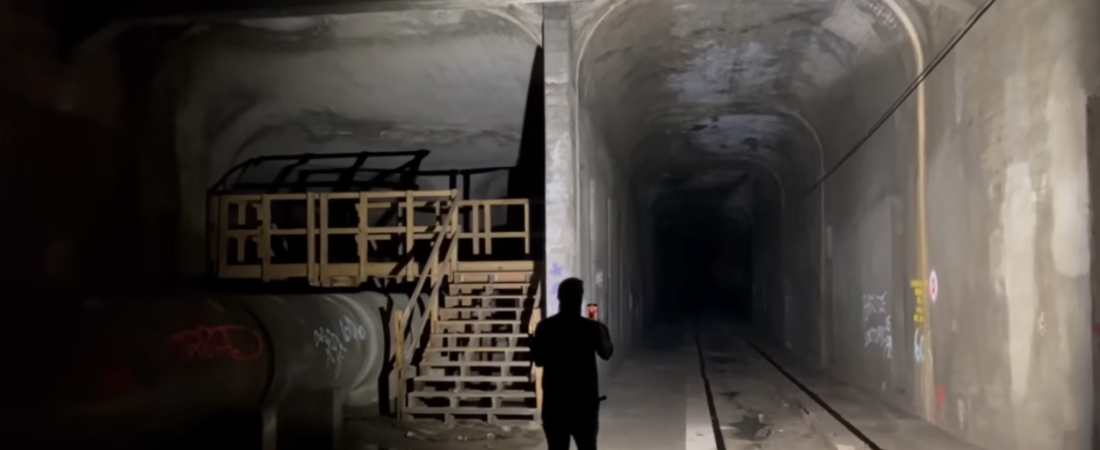
To enter this underground world one has to overcome difficult physical barriers, such as steep descents, narrow entrances, and total darkness. When urban explorers go into these underground areas they have to depend wholly on strong lighting and safety equipment since any natural light disappears completely just a short distance beyond the entrance points.
Station Platforms, Cold War Artifacts, and Subterranean Infrastructure
The different stages of the city’s abandoned rapid transit project are shown by the various sections of the network, which were all constructed during the original building period.
Abandoned Passenger Platforms
There are several large station areas in the tunnels, consisting of wide concrete platforms on which thousands of daily commuters were to wait for the trains coming in. The stations show architectural features from the 1920s such as original wooden staircases, arching vaulted ceilings, and assigned track lanes. Although modern graffiti adorns the external entrances, the deeper station platforms are still remarkably well preserved and remain in complete darkness.
Cold War Adaptations
In the middle years of the 20th century, when worries about nuclear weapons increased during the Cold War, city planners looked at the former subway system from the point of view of civil defence. Some of the deeper underground stations were made into emergency air-raid shelters. Signs of that time can still be seen in the deeper stations, since there metal bunk beds, emergency medical cots and civil defence supplies had been stored for the purpose of sheltering civilians in the event of an attack.
Modern Utility Arteries
Even though passenger trains never made use of the underground network, the city has over time found other purposes for these reinforced concrete routes. Important urban infrastructure, such as the main water pipes and the municipal fibre-optic cables, passes directly through parts of the main tunnels. These essential telecommunications lines link up the city’s emergency services, local hospitals, and the regional police departments, making the area an active yet silent backbone of the distribution of municipal utilities.
The Reality of Underground Exploration
The physical conditions found in abandoned transit tunnels are unlike those in ordinary above-ground environments. Because of the insulating effect of the deep earth, temperature control within the tunnels is separate from changes in surface weather. In the summer, the temperature inside falls considerably, producing cold drafts beneath the surface where explorers are often able to see their breath.
The physical landscape is just as difficult. The track beds are lined with thick layers of industrial mud, accumulated dust, silt deposits, and standing water. There are also structural remains, fallen masonry, and rusted metal fittings that have to be negotiated with care. In the most deeply situated parts, silence prevails, being interrupted only by water dripping from the vaulted ceilings or by the distant rumble of surface vehicle traffic echoing through the concrete tunnels.
The tunnels act as a clear indication of past attempts at urban planning and show how unpredictable municipal investments in infrastructure can be; the Cincinnati subway is a preserved example of 1920s engineering and an incomplete part of America’s transit history that has been kept beneath the present-day urban area.
REFERENCES:
Video: Inside Americas Largest Abandoned Subway System…
Source: 2swag, (published on: 2025-11-17)
Summary: The video presents a thorough journey into North America’s biggest abandoned underground subway system in Cincinnati. It looks at the historical background of the 1920s project—which had cost $6 million (almost $100 million in today’s money)—and then shows the team as they go through sealed entrances, pass through flooded sections, visit the original station platforms, see the emergency medical beds from the Cold War era, and inspect the important city fiber-optic infrastructure before leaving at sunrise.