
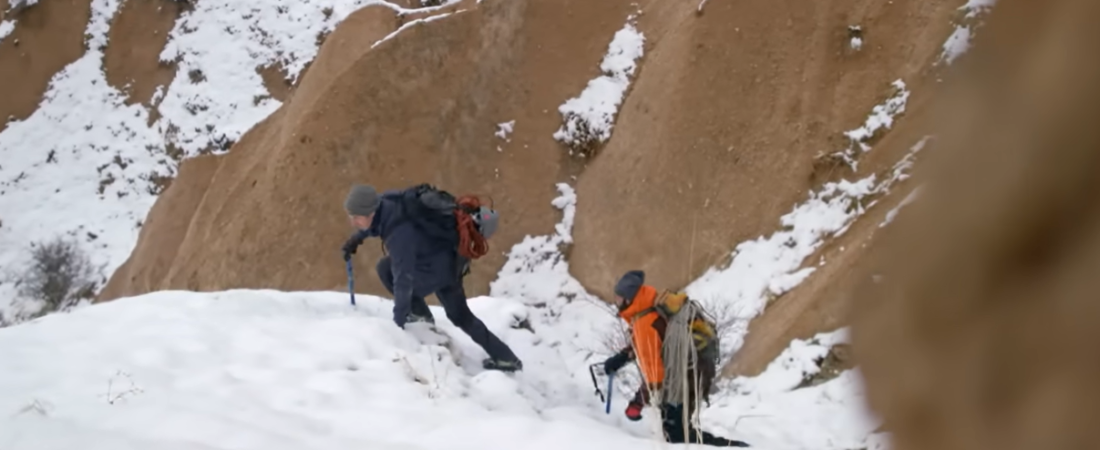
One of the most remarkable architectural and archaeological wonders known to humanity is situated deep within the rugged, sun-exposed area of central Turkey. In the region of Cappadocia, famous for its strange geological features called “fairy chimneys”—which are tall spires of eroded volcanic rock that create a sharp, otherworldly landscape—there is a real mystery that is entirely concealed beneath the feet of present-day tourists.
For many years historians and archaeologists had the belief that the various underground complexes found all over Cappadocia were simply separate emergency shelters constructed by the different civilizations in the region in order to escape military invasions. It is only recently, thanks to major breakthroughs, pioneering excavations, and revolutionary dating techniques, that conventional archaeology has been completely overturned.
It now appears that these enormous stone-cut underground structures might in fact form part of a connected ancient megalopolis, that is, a vast underground civilization which was constructed not about a thousand years ago but rather tens of thousands of years ago in order to survive a disastrous global climate event.
- The Shocking Discovery Underneath the Earth
The account of the way modern society has rediscovered these ancient underground wonders sounds as if it’s directly out of a Hollywood adventure movie. In 1972 a Turkish farmer living in the Özkonak area noticed something very unusual when he was watering his fields: water was mysteriously vanishing through a deep crack in the ground.
Being curious and concerned, he removed the debris and found an opening which led down into the dark. Upon finally entering the hole, the researchers were amazed to discover a huge, multi-level human city carved directly from the underground volcanic tuff rock.
The place now known as Özkonak was by no means a discovery made all by itself. During the years that have passed, archaeologists have dug up a number of underground complexes, among them the well-known sites of Derinkuyu and Kaymaklı. These are not merely ordinary, crudely cut caves; they are civilisations’ masterfully engineered structures featuring:
Ventilation shafts of a sophisticated design: vertical channels that extend hundreds of feet downwards, supplying fresh air all the way to the lowest levels.
The domestic infrastructure is complex and includes fully functional kitchens, olive oil presses, wine storage facilities, stables, communal dining halls, and living quarters.
There are complex defence systems in the form of huge circular stone doors, each weighing thousands of pounds, which could only be rolled shut from within in order to prevent intruders from getting through.
To prevent poison attacks during sieges, the internal wells and water conduits were separated from the surface water sources.
For many years the prevailing academic theory had been that these cities had been built about 3,000 years ago in the Iron Age, or possibly developed later by Christians who were fleeing persecution at the hands of the Romans. However, as excavation techniques advanced, a surprising conclusion appeared: these underground systems are much larger and considerably older than had ever been imagined.
- A Megalopolis Beneath the Surface: The Connected Underworld
At the time when the researchers first started to excavate sites such as Özkonak and Derinkuyu, they believed that each of these complexes functioned on its own. Nowadays, however, archaeologists think that these cities were linked by miles of tunnels which had been manually cut.
Rather than having a number of separate shelters designed to protect just a few thousand refugees, there is evidence for an interconnected underground system—an old kind of “suburban sprawl” which is capable of accommodating hundreds of thousands of people below the surface.
It is now believed that there could be up to 200 underground cities lying beneath the Cappadocian area. The amount of rock removed by hand is amazing. Estimates suggest that thousands of tons of volcanic stone were slowly dug out by means of simple hand tools made of stone or bronze—an operation which would have required decades or even centuries of continuous labor and a high degree of social organisation.
This leads to a most important historical question—namely, who had the organizational ability, engineering skills, and motivation needed to construct a large underground civilization?
- Rewriting history: Were the Hittites the creators or the occupants?
For many generations the Hittites–a powerful ancient Anatolian empire which reached its height around 1500 BC–were believed to have been the ones who built the Cappadocian underground structures. In 2019 archaeologist Halil Saccharal discovered a set of 3,500-year-old Hittite hieroglyphs at a nearby cave site. These inscriptions showed mountain symbols, indicating that the Hittites had laid claim to the regional mountains and the surrounding area.
On the other hand, independent researchers and alternative archaeologists claim that the discovery of Hittite artifacts or inscriptions at or near these sites does not prove that the Hittites constructed them; rather, the evidence indicates that the Hittites were only secondary occupants who inherited and altered the buildings which had already been empty for thousands of years.
Archaeological surveys which looked at the rock debris and the patterns of the chips near the complexes have uncovered something remarkable in that the origin of these rock excavations goes back much further than the Hittite Kingdom; some researchers now assign the first construction of these underground cities a date of between 11,000 and 12,000 years ago—deep in the Stone Age.
- The Link with Gobekli Tepe and the Missing Chapter in Human Civilization
In order to find out how humans during the Stone Age could have had the ability to carve whole cities out of solid rock, historians have looked at another site nearby which greatly changed our understanding of human prehistory: Göbekli Tepe.
Göbekli Tepe, which is about 200 miles to the southeast of Cappadocia, is officially regarded as the oldest known temple complex in the world and dates from about 9600 BC (that is more than 11,500 years ago). The site includes enormous T-shaped stone pillars, intricately carved, arranged in megalithic circles and decorated with high-relief three-dimensional sculptures of predators, reptiles, and abstract astronomical symbols.
The discovery of Göbekli Tepe destroyed the long-established archaeological belief that hunter-gatherer societies did not have the social hierarchy, engineering knowledge, and division of labour necessary to construct megalithic stone monuments.
If the Stone Age people of Anatolia had the mathematical, artistic, and engineering abilities needed to quarry, transport, and erect the huge stone pillars at Göbekli Tepe, then it is reasonable to conclude that the same culture—or a related regional civilization—must also have had the capacity to dig out the underground cities of Cappadocia.
It therefore indicates that 12,000 years ago there existed in central Turkey a sophisticated, very organized, and socially complex human culture which extended over hundreds of miles—making it a possible origin point for the first “cradle of human civilization.”
- The Younger Dryas Cataclysm: Why did they go underground?
Why would an advanced prehistoric culture have moved its whole society underground if it had built these enormous underground cities? Since digging a city beneath the earth involves an enormous commitment of time and resources, people would not have chosen to live in completely dark stone tunnels unless there was some sort of existential threat.
The solution could be found in the stars and in the carvings on the stone pillars of Göbekli Tepe.
The leading scientific theories, which have been backed by researchers including Dr. Martin Sweatman from the University of Edinburgh, link these ancient sites with a catastrophic cosmic event referred to as the Younger Dryas Impact Event.
About 12,800 years ago (that is, about 10,900 BC), pieces from a huge comet that was breaking up struck the Earth’s atmosphere. The collisions caused extensive forest fires, produced atmospheric shockwaves, and led to rapid and catastrophic global climate change. As a result, the planet entered the ‘Younger Dryas’–a sudden and severe mini-ice age which lasted for about 1,300 years.
In this cosmic winter surface temperatures dropped sharply all over the Northern Hemisphere and for those people living in central Turkey the surface conditions became severe, freezing and mostly uninhabitable.
Surviving the Cosmic Winter
In the face of a thousand-year winter and all-around environmental chaos, those ancient people came up with a brilliant strategy for survival: to go underground.
By shifting their society underground into the volcanic rock of Cappadocia, they established a thermally stable environment. The deep stone rooms kept a steady, ambient temperature throughout the year and thus protected humans, their livestock, and the stored grain from the severe freezing surface temperatures and cosmic fallout.
When the Younger Dryas period came to an end around 9600 BC and global temperatures started to rise, the survivors reappeared on the surface. In order to remember their survival and to record the disastrous comet impact for future generations, they built the megalithic pillars at Göbekli Tepe, carving astronomical symbols and images of comets into the stone pillars as a permanent historical record.
Conclusion: A Paradigm Shift in Human Prehistory
The underground cities of Cappadocia are much more than just a fascinating tourist spot or an example of ancient engineering. They serve as quiet monuments to what humans have achieved in terms of resilience, ingenuity, and adaptability during a crisis affecting the planet.
The traditional timeline of human history is being fundamentally rewritten as archaeologists go on mapping the underground tunnels in Turkey and studying the astronomical alignments of the ancient megaliths. A forgotten and highly advanced prehistoric society existed in central Anatolia long before the emergence of Ancient Egypt, Mesopotamia, or the Hittite Empire, carving out an underground world which enabled humanity to survive one of the most severe climate catastrophes in Earth’s history.
REFERENCES:
Video: Ancient Underground City Discovered in Turkey | Cities of the Underworld (Season 1) | History
Source: HISTORY, (published on: 2021-10-20)
Summary: Hosted by Eric Geller, this episode explores the vast ancient underground cities of Cappadocia, Turkey, such as Özkonak. The episode highlights new archaeological theories suggesting these complex subterranean networks-potentially connecting multiple subterranean cities-are far older than previously thought. Instead of being built by the Hittites 3,500 years ago, evidence linking the sites to Göbekli Tepe suggests they may have been constructed 12,000 years ago during the Stone Age as shelters to survive a thousand-year ice age caused by a catastrophic comet impact.