
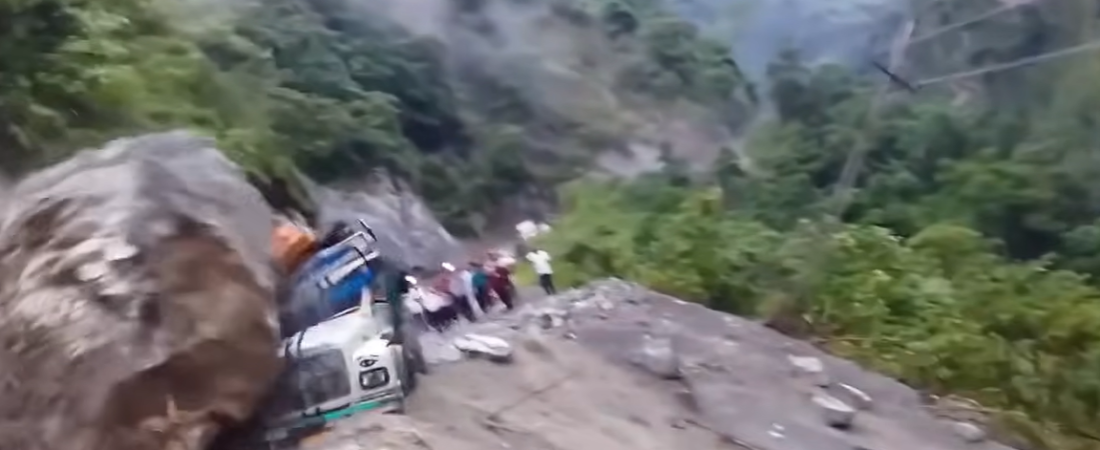
The Distinct Boundary Between Calm and Chaos: Why Seconds Count
Life can proceed at a completely ordinary pace—a typical commute, a quiet day spent on the water, or a pleasant walk in the countryside—until a single fraction of a second causes everything to turn completely upside down. Footage taken all around the world constantly serves as a reminder of just how easily safety can be compromised. Whether the cause is unpredictable natural forces, flaws in construction, or unexpected human mistakes, near-misses underline the extremely narrow margin between absolute calm and sudden disaster.
Studying these widely shared incidents is not merely about creating a sense of shock; it provides important lessons in physics, the upkeep of structures, the safety of infrastructure, and awareness of the environment. Below, we examine some key real-life events, explain why they happen, and show how reactions in a split second can make all the difference.
Identifying Hidden Underground Dangers: Sinkholes and Vulnerability of Infrastructure
One of the most frightening infrastructure problems recorded on video is the sudden formation of a sinkhole. Unlike visible road blockages, sinkholes usually show no sign of surface damage until the ground directly below actually collapses.
How Sinkholes Form
Sinkholes mainly occur in areas where the bedrock beneath the surface is made up of soluble rocks, such as limestone, salt deposits, or carbonate rocks. Over time, groundwater that is circulating dissolves the rock, forming large underground cavities.
Natural Dissolution: Rainwater takes in carbon dioxide from the soil, becoming slightly acidic. As it flows underground, it slowly wears away the bedrock.
Subsurface Erosion: The soil above the cavity gradually settles into the void, a process known as cover-collapse.
Catastrophic Failure: The top layer of asphalt or soil loses all support and collapses either under its own weight or because of the weight of vehicles passing over it.
Modern sinkhole incidents, such as those that happen near major construction sites or in urban road areas, are often made worse by broken underground water pipes or underground excavation work. It is essential to carry out regular municipal surveys using ground-penetrating radar (GPR) and to conduct routine pipe inspections in order to detect these hidden dangers before major road failures occur.
Risks in Transportation: The Physics of Braking and Vehicle Accidents
Roads and railway crossings remain high-risk situations where the outcome is determined by reaction time and the laws of physics.
The Physics of Heavy Machinery and Long Braking Distances
Trains and heavy vehicles need a great deal of distance to come to a complete stop. A fully loaded freight train travelling at normal speeds can take more than a mile to stop completely once the emergency brakes are activated.
When drivers ignore railway clearance signals, lowered gates, or flashing warning lights, the engines are simply unable to stop within a few seconds because of their immense momentum ($p = mv$). Safety rules state that if a vehicle becomes stuck or is stalled on the tracks, the occupants should immediately leave the vehicle and move diagonally away from the tracks toward the oncoming train in order to avoid being hit by flying debris.
Human Factors in Aviation and Automotive Safety
Statistics from transportation safety agencies show that human error is responsible for more than 70% of transportation-related accidents. The main causes of these preventable mistakes are:
Micro-sleeps and Fatigue: Driving or operating machinery without having had enough rest greatly reduces spatial awareness and reaction times.
Low-Altitude Maneuvers: In aviation, flying below safe altitudes reduces the time available to recover from unexpected stalls or engine failures.
Lack of Buffer Zones: At motor races or rally events, when spectators enter areas that are not designated for them, they run great risks. After sudden jumps or landings, vehicle suspensions can become misaligned, causing the cars to drift far off course.
Environmental Forces: Avalanches, Flash Floods, and Severe Weather
Nature has forces that go well beyond what human engineering can handle. Videos of extreme weather events illustrate why paying attention to early warnings is the best possible protection.
Avalanche Dynamics
Avalanches happen when a dense layer of snow lying on top of a weak layer beneath it loses its grip. This can be set off by sudden changes in temperature, wind-blown snow buildup, or human activity. Once the upper layer breaks off, thousands of tons of snow slide down a slope at speeds over 80 mph (130 km/h), destroying everything in its path.
Flash Floods and the Speed of Water Currents
Flash floods are exceptionally fast. Heavy rain upstream can turn dry creek beds or small streams into powerful rivers within minutes. The water exerts a huge force on buildings; even a current moving at a moderate speed can erode the foundations of bridges at their weakest points, causing structural instability that is completely concealed beneath the surface.
In a similar way, maritime navigation demands a deep respect for currents and momentum. Unlike land vehicles, boats cannot make immediate changes in direction. Turning against strong winds or currents requires a considerable distance, so offshore operations become dangerous during severe weather.
Wildlife Encounters: The Need to Keep Safe Distances
Video footage of human-wildlife interactions frequently shows the dangers of intruding on wild animals’ personal space. Large animals—such as bison, baboons, or mother animals protecting their young—have strong defensive instincts.
Buffer Zones: Park authorities require people to stay a safe distance away from large wildlife. As soon as you enter their territory, their behaviour changes instantly from passive feeding to active defence.
Predictability: Wild animals do not think like humans. A situation can shift from peaceful observation to a dangerous charge in a matter of seconds.
Important Points for Personal and Public Safety
Respect warnings about infrastructure: Never go past lowered railroad gates, ignore construction barriers, or drive through standing water that covers a road.
Make maintenance a priority: For both personal vehicles and public transport systems, regular checks of the brakes, tyres, electrical insulation, and structural integrity are essential safety measures.
Never put your safety at risk for the sake of filming: Trying to record extreme weather, wildlife, or high-speed stunts without the proper safety clearances greatly increases the chances of a serious incident.
REFERENCES:
Video: 120 Incredible Moments Caught on Camera | Moments Filmed Seconds Before Disasters | 2026 New Update
Source: GOHA – Moments, (published on: 2026-09-06)
Summary: The video is a collection of surprising near-misses, natural disasters, sinkhole collapses, transportation accidents, and other extreme events which have been recorded on camera, including comments regarding public safety, the weaknesses in infrastructure, precautions needed when it comes to wildlife, and the physical principles at play in the split-second accidents.